What It Is
Gaun Sao — the “cultivating hand” or “ploughing hand” — is a downward diagonal deflection that addresses attacks targeting the lower gates. The arm moves downward and outward, redirecting an incoming low strike or grab away from the body's centreline while maintaining structural connection to the core.
It appears in Chum Kiu and the wooden dummy form, and it's one of the techniques that practitioners who haven't seen it applied well tend to underestimate. It looks like a simple downward block. It's considerably more than that.
The Low Gate Problem
Most Wing Chun practitioners spend the majority of their Chi Sao time working the high and middle gates. The low gate — attacks targeting the ribs, stomach, or lower centreline — gets less attention. Gaun Sao is your primary structural answer to that problem, and its effectiveness depends entirely on whether you've actually drilled it against low attacks with a partner applying real pressure.
A Gaun Sao drilled only in forms practice is a shape. A Gaun Sao that's been tested against someone genuinely trying to land a low strike is a technique.
The Structural Requirement
The most common error in Gaun Sao is losing centreline connection during the downward movement. When the arm drops, there's a tendency for the shoulder to roll forward and the elbow to drift away from the body's centreline. When that happens, the deflection becomes mechanical rather than structural — it's the arm working alone rather than the body's structure expressed through the arm.
The correction is to maintain the feeling of the elbow connecting back to the centre throughout the movement. The arm goes down; the connection doesn't change.
Gaun Sao in Combination
Gaun Sao is rarely used in isolation. The most natural combination is Gaun Sao deflecting the low attack while the other hand simultaneously or immediately strikes high — the classic Wing Chun high-low split that creates a targeting problem for the opponent. Drilling this combination until the two movements feel simultaneous rather than sequential is the training goal.
What the Wooden Dummy Teaches
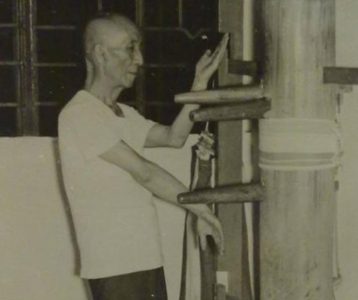
The wooden dummy form contains several Gaun Sao applications that clarify what the technique is actually for. The dummy's lower arm provides a fixed reference point that allows you to feel whether your Gaun Sao is genuinely deflecting or just making contact. If the contact point moves — if your deflection is actually redirecting the dummy's arm position rather than just hitting it — your Gaun Sao has structural quality. If the dummy arm doesn't move, you're tapping, not deflecting.
Can You Learn Gaun Sao Online?
Yes. Gaun Sao is taught step by step in Kung Fu Kendra’s Wing Chun Online Certification Course, a 10-level program taught by 3rd generation Ip Man lineage master Sifu Kendra Mahon (Grandmaster William Cheung, 1st generation; Master Brian Lewadny, 2nd generation). Every level has a graded exam, students get direct feedback, and it is a single one-time fee with no monthly payments.
Kendra’s Verdict
Gaun Sao is one of those techniques you don't appreciate until you train with someone who uses it well. Then you never stop working on it.