What It Is
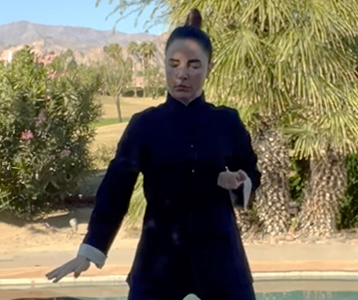
Gum Sao — “pinning hand” or “pressing hand” — is a downward press that intercepts and controls a low attack or an opponent’s arm. The palm faces down, the hand presses toward the ground, and the action typically addresses a strike coming to the body or lower gates.
The Low-Gate Problem
Many Wing Chun practitioners spend the majority of their Chi Sao time dealing with the upper and middle gates. The lower gate — attacks to the ribs, body, and below — gets less attention. Gum Sao is one of the primary answers to that gap, and if you haven’t drilled it against lower attacks specifically, you’ll find yourself improvising badly when they come.
Drilling Gum Sao against committed body shots from a training partner is genuinely uncomfortable and genuinely valuable. The technique works differently when the incoming force is real and aimed lower than your comfortable training range.
Gum and Lap — A Natural Pairing
Gum Sao pairs naturally with Lap Sao (the pulling hand). The downward press of Gum Sao controls the opponent’s limb from above; Lap Sao grabs and redirects. Understanding how these two techniques relate to each other — and how they set each other up — is a useful structural principle for the whole system.
Structure, Not Force
The temptation with Gum Sao is to muscle it. Against a larger, stronger attacker, your arm strength isn’t going to win a force-on-force competition at a downward angle. The technique works when the structure behind the press comes from the spine and the stance, not the shoulder and tricep.
Why It Gets Overlooked
Gum Sao appears in the forms, gets mentioned in classes, and then largely disappears from most practitioners' active technique vocabulary. The reason is that it requires a very specific entry condition — the opponent's arm must be in a position where downward pressure creates the desired control — and that condition doesn't arise as obviously as the setups for Pak Sao or Lap Sao.
The practitioners who use Gum Sao well have usually drilled it in very specific scenarios rather than treating it as a general-purpose technique. Know when it works. Don't try to make it work in conditions where it doesn't belong.
The Control Principle
What Gum Sao does well — better than almost any other Wing Chun technique — is establish control over the opponent's lower arm gate without requiring significant force. The pinning pressure is applied through structural weight rather than muscular effort, which means it can be maintained even under some resistance without fatiguing.
This makes it useful in scenarios where you need to hold a limb while doing something else with your other hand. Gum Sao pins; the other hand acts. That combination has real application in close-range exchanges where both arms are engaged.
Drilling Gum Sao
The most productive way to drill Gum Sao is in the context of failed or redirected techniques. Start with a Pak Sao that doesn't fully clear the arm — the natural follow-up is sometimes Gum Sao rather than a strike, to reestablish control before the counter-attack. Drilling this sequence builds realistic context for when Gum Sao actually appears.
Gum Sao as an isolated technique is less useful than Gum Sao as a natural consequence of a technique that didn't fully resolve. In that context, its role becomes clear: it's the recovery before the finishing move, not the finishing move itself.
In Combination With Striking
The most common combination I teach is Gum Sao followed immediately by an inside strike — the pinning hand suppresses the arm while the other hand attacks the face or throat. Practised slowly, students often find the timing feels awkward because they want to complete the pin before striking. Eliminate that pause. The strike begins as the pin completes, not after it.
Can You Learn Gum Sao Online?
Yes. Gum Sao is taught step by step in Kung Fu Kendra’s Wing Chun Online Certification Course, a 10-level program taught by 3rd generation Ip Man lineage master Sifu Kendra Mahon (Grandmaster William Cheung, 1st generation; Master Brian Lewadny, 2nd generation). Every level has a graded exam, students get direct feedback, and it is a single one-time fee with no monthly payments.
Kendra’s Verdict
Gum Sao reveals your structural understanding more honestly than the flashier shapes. If it’s working through force, you’re not there yet. When it’s working through structure, you’ll feel the difference immediately.